
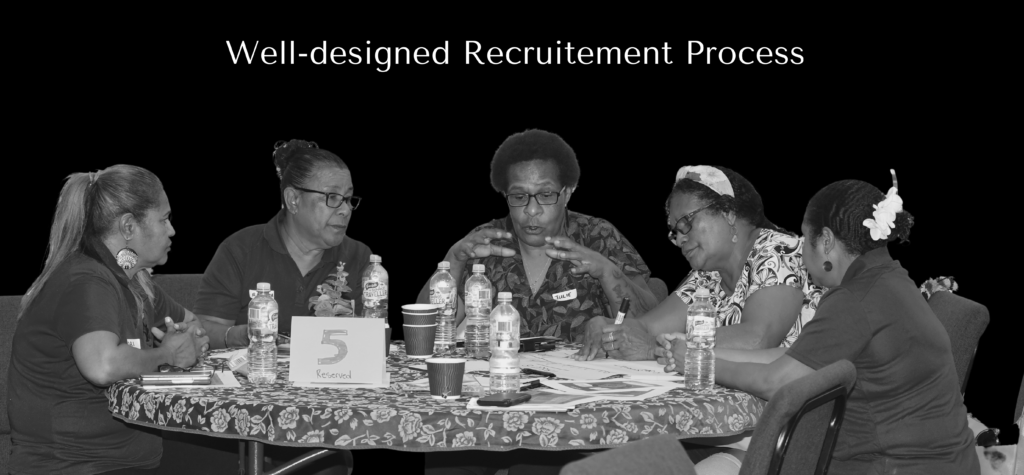
Recruitment in the PALM scheme isn’t just about filling roles. It’s about designing a process that respects Pacific cultural norms while meeting Australian compliance and productivity expectations.
1. Culturally Anchored Recruitment Pathways
Takeaway: Build recruitment processes that reflect Pacific social structures, not just Western HR norms.
Why it matters.
Pacific workers often make decisions collectively – with family, church, and community leaders playing a central role. When recruitment ignores these dynamics, workers may withdraw late in the process or arrive unprepared for the realities of Australian work.
What this looks like in practice
Community‑based information sessions delivered through churches, village councils, and women’s groups.
Use of local languages in job descriptions, expectations, and rights/responsibilities.
Collective decision checkpoints (Talanoa), where families can ask questions before workers commit.
Story‑based communication, using real worker experiences rather than abstract policy language.
Benefits
Higher retention
Fewer misunderstandings
Stronger trust between sending communities and employers
2. Job‑Readiness Through Pacific‑Centred Pre‑Departure Training
Takeaway: Prepare workers with training that respects cultural norms while meeting Australian compliance and productivity expectations.
Why it matters
Australian employers need workers who understand safety, punctuality, and productivity expectations. Pacific workers need clarity delivered in a culturally resonant way.
What this looks like in practice
Scenario‑based training using real Australian workplace examples (e.g., “What happens if you’re late to a shift?”).
Cultural bridging modules that explain differences in communication styles, hierarchy, and conflict resolution.
Hands‑on demonstrations for WHS, PPE use, and equipment basics.
Financial literacy training tailored to remittances, budgeting, and obligations to family and reintegration.
Employer‑recorded welcome videos to humanise the workplace before arrival.
Benefits
Faster onboarding
Fewer safety incidents
Reduced cultural friction
Workers feel respected and prepared
3. Partnership‑Driven Selection and Matching
Takeaway: Move from transactional recruitment to a partnership model where employers, Pacific governments, and communities co‑design the selection process.
Why it matters
Employers often want reliability and skill fit. Pacific communities want fairness, transparency, and opportunities for those who will uplift their families. A partnership model aligns both.
What this looks like in practice
Co‑developed selection criteria that balance employer needs (e.g., physical fitness and English level) with community values (e.g., fairness and gender balance).
Transparent shortlisting shared with community leaders to avoid perceptions of favouritism.
Employer participation in interviews, either in person or virtual, to build early rapport.
Use of practical assessments, such as lifting tests, teamwork tasks, or basic numeracy checks.
Feedback loops after each recruitment round to refine the process.
Benefits
Better job–worker matching
Stronger employer confidence
Reduced dropout rates
Community endorsement of the scheme